
While Google Search Console continued to report traditional search performance, it offered little insight into how websites performed within AI-generated search experiences.That is finally beginning to change.
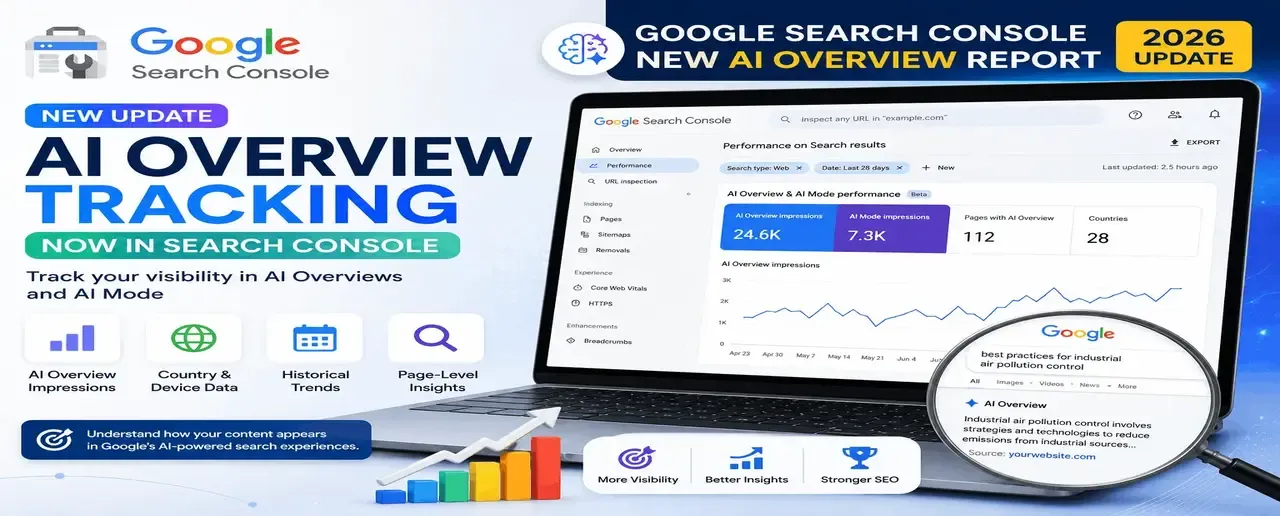
Google has introduced a dedicated Search Generative AI Performance Report in Search Console, providing website owners with their first official way to measure visibility in AI-powered search experiences, including AI Overviews and AI Mode. Although the rollout is gradual, the announcement marks a significant step toward making AI overview tracking part of mainstream SEO.
However, before you celebrate, it’s important to understand what the report actually measures and, more importantly, what it doesn’t.
Why AI Overview Tracking Matters
Google Search is evolving from a list of links into an answer engine.
AI Overviews now generate complete answers for millions of informational queries before users even scroll to the organic results. While these summaries cite multiple sources, many searches end without a click because users find their answers directly within Google’s AI response.For marketers, this changes the way search success is measured.
Traditional SEO focused on rankings, impressions, and clicks. Modern Google AI Overview SEO requires understanding whether your content is chosen as a reliable source for AI-generated answers. If you cannot measure that visibility, optimizing for it becomes guesswork.This is precisely where AI overview tracking becomes valuable.
What Google’s New AI Overview Report Shows
Google’s new report lives under the Performance section of Search Console as a separate view for generative AI search experiences. Instead of mixing AI visibility with standard search performance, it isolates your site’s presence within Google’s AI-powered features.
Currently, the report includes impression-based data for:
- AI Overviews
- AI Mode
- Future supported generative search features
You can also segment this data by:
- Individual pages
- Device type
- Country
- Date
This allows you to answer questions such as:
- Which pages appear most often in AI Overviews?
- Which countries generate the highest AI impressions?
- Has AI visibility increased after publishing new content?
- Which devices trigger the most AI appearances?
For the first time, Google is providing first-party evidence that your content is surfacing in its generative search experience, rather than forcing marketers to rely solely on third-party tools.
Where to Find the Report
If your property has access, you’ll find the new report inside Performance → Generative AI within Google Search Console.
Google is rolling out the feature gradually, so not every website will see it immediately. Sites with limited AI impressions may also need to wait until sufficient data has accumulated before the report becomes available.
What’s Still Missing
Although the new report is a welcome addition, it doesn’t provide the complete picture many SEO professionals were hoping for.
Here’s a comparison.
Available Today | Still Missing |
AI impressions | AI-generated clicks |
Pages appearing in AI features | Exact citation location |
Device data | Which sentence or paragraph was referenced |
Country data | Competitor comparisons |
Date trends | Prompt-level reporting |
AI Overview visibility | Citation frequency across queries |
The biggest limitation is that the report focuses on visibility rather than engagement.
Knowing your page appeared inside an AI Overview is useful, but it doesn’t tell you:
- whether users clicked through,
- how prominently your page was cited,
- whether Google summarized your content accurately,
- or why one page was chosen over another.
In other words, AI overview tracking has improved, but it is still far from complete.
How to Track AI Overviews More Effectively
Google Search Console should become your primary source for first-party AI visibility data, but it shouldn’t be your only source.
A more complete AIO tracking strategy combines multiple data points:
- Monitor AI impressions in Search Console.
- Compare organic traffic trends in Google Analytics 4.
- Perform manual searches for high-value keywords.
- Use AI search monitoring platforms to track citations.
- Track brand mentions across AI search engines beyond Google.
This layered approach provides a much clearer picture than relying on a single dashboard.
As AI search expands beyond Google into platforms like ChatGPT, Perplexity, and Gemini, measuring visibility across multiple ecosystems will become increasingly important.
What This Means for AI Overview Optimization
The introduction of official reporting also changes how marketers should approach AI overview optimization.
Rather than chasing rankings alone, focus on making your content easier for Google’s AI systems to understand and reference.
Some proven best practices include:
Build topical authority
Publish comprehensive content clusters that cover an entire subject instead of isolated articles.
Answer questions directly
AI Overviews often extract concise explanations. Clear definitions, summaries, and step-by-step answers improve your chances of being cited.
Improve content structure
Use descriptive headings, bullet points, comparison tables, and logical hierarchy to help both users and AI systems understand your content.
Keep information current
Google’s AI systems favor fresh, accurate content, particularly for rapidly changing topics.
Strengthen entity relationships
Mention relevant brands, products, concepts, and industry terminology naturally throughout your content. This helps search engines better understand your expertise.
These practices won’t guarantee inclusion in AI Overviews, but they align closely with Google’s broader emphasis on helpful, authoritative content.
Is Google Search Console Enough?
Not yet.
Search Console now provides the most reliable first-party data for an AI-driven overview of Google visibility, but it only covers Google’s own ecosystem.
It doesn’t monitor:
- ChatGPT citations
- Perplexity answers
- Claude responses
- Cross-platform AI visibility
- Competitive AI share of voice
For businesses investing heavily in AI search, dedicated AI SEO platforms still provide valuable insights that Search Console doesn’t yet offer.
Think of Google’s report as your foundation and not your complete measurement framework.
The Bigger Picture
Google’s new Search Generative AI report represents one of the most significant Search Console updates in recent years.
For the first time, website owners have official visibility into how their content performs in AI-powered search experiences, rather than relying entirely on estimates.
At the same time, the report reminds us that AI overview tracking is still evolving. Visibility is only one part of the equation. Understanding citations, user behavior, click-through performance, and competitive presence remains a challenge.
As Google continues refining its AI search experience, it’s reasonable to expect richer reporting in future updates. Until then, the smartest strategy is to combine Search Console data with broader AI overview optimization practices and continue building content that demonstrates expertise, authority, and genuine value.
The era of optimizing only for rankings is ending. The next phase of SEO will be about earning visibility within AI-generated answers, and now, for the first time, we finally have a way to measure it.
Further reading: Google announced the new Search Generative AI performance reports on the Google Search Central Blog, outlining what the reports include, their rollout, and how they help website owners measure visibility in AI Overviews and AI Mode.